
Mission success cannot be jeopardized by molecular outgassing and contamination of sensitive hardware. Dynavac leverages its expertise in space simulation to deliver high-performance Vacuum Bakeout Systems. Our systems provide precision and reliability to support all your bakeout needs, ensuring the integrity of your mission-critical hardware.
Vacuum Bakeout Chambers
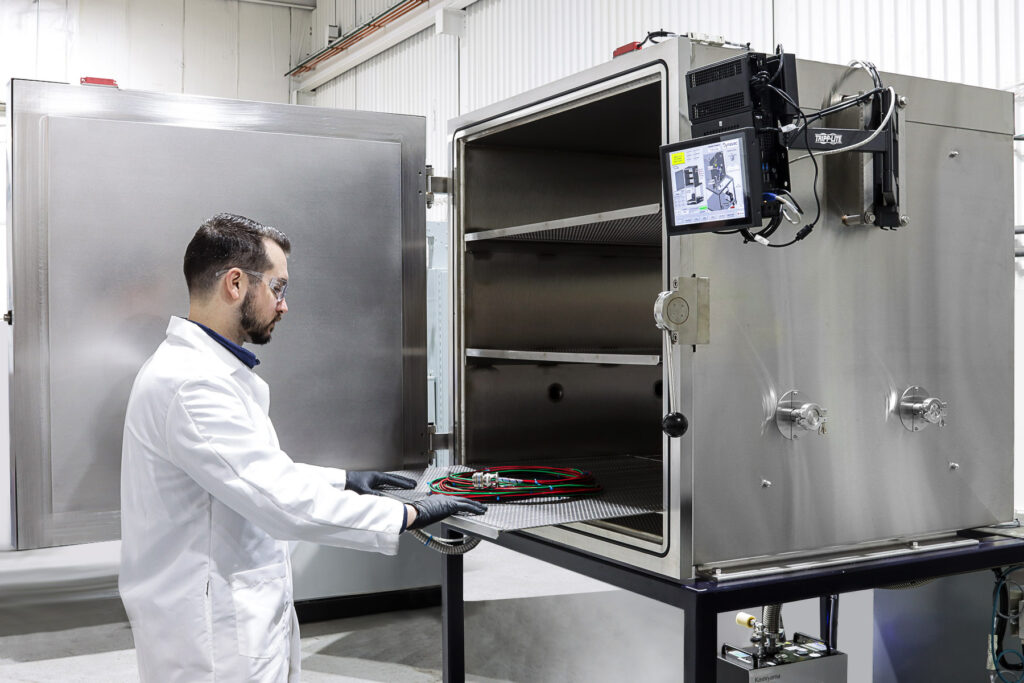
What Is a Vacuum Bakeout Chamber and Why Does It Matter?
A vacuum bakeout chamber is a controlled environment used to drive adsorbed water vapor, hydrocarbons, and other volatile contaminants out of spacecraft hardware before it goes into thermal vacuum testing or flight. The process combines elevated temperature with high vacuum, accelerating the desorption and removal of molecular contaminants that would otherwise outgas slowly, or at the worst possible time, during a mission.
The problem with skipping or shortcutting this step is well understood in the space community: even trace levels of molecular contamination can degrade optical surfaces, foul sensors, impair thermal coatings, and compromise instrument performance. Contamination that bakes off a solar array or structural component in orbit doesn’t dissipate; it migrates to the coldest nearby surface, which is often exactly where you don’t want it.
A dedicated vacuum bakeout system handles this before it becomes a mission risk. Dynavac’s chambers are built for this application, with precise temperature uniformity, deep vacuum capability, and monitoring options that let you verify that your hardware is clean.
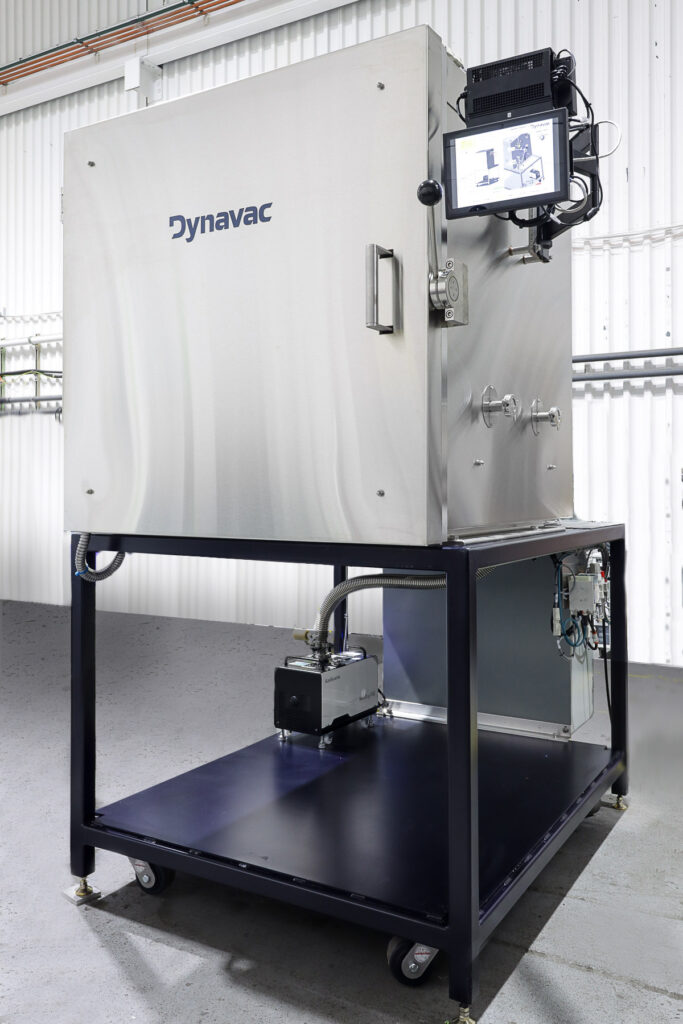
Vacuum bakeout system highlights
- Chamber sizes 24 inches and up
- Temperature: Ambient to 150C+
- Vacuum levels of better than 10-6 torr
- Removable work shelves
- Set point control and data logging
- Contamination monitoring and data acquisition available
Thermal Vacuum Bakeout vs. Thermal Vacuum Testing: Understanding the Difference
These two processes often get conflated, but they serve different purposes and are typically performed in sequence.
Thermal vacuum bakeout is a contamination control process. The goal is to reach a stable outgassing rate, indicating that volatile contaminants have been driven off. ASTM E2900 defines three accepted methods for certifying bakeout completion, and most launch providers require documented compliance.
Thermal vacuum testing (TVT) subjects hardware to the temperature extremes and vacuum levels it will encounter in space, verifying that it will function within spec under those conditions.
Bakeout comes first, and for good reason: conducting thermal vacuum testing on hardware that hasn’t been properly baked out risks contaminating the TVAC chamber itself, potentially compromising future test articles.
Dynavac designs both thermal vacuum chambers and dedicated vacuum bakeout systems, so whether you need one or both, or a facility that handles the full sequence, we can configure the right solution.

What a Vacuum Bakeout Oven Handles
While “oven” and “chamber” are sometimes used interchangeably in this context, a vacuum bakeout oven typically refers to a smaller, more batch-oriented system for components and subassemblies rather than full spacecraft. These are common in environments where multiple programs share a facility, or where components need to be certified clean before integration.
Dynavac’s systems accommodate a range of article sizes starting at 24 inches, with removable work shelves that let you configure the chamber to fit the hardware. Whether you’re baking out a single optical instrument or a rack of subassemblies in parallel, the chamber gives you consistent, repeatable results.
Talk to a Dynavac Engineer
Bakeout requirements vary by program, hardware, and contamination specification, and the right system configuration depends on those specifics. Whether you’re designing a new facility, replacing aging equipment, or evaluating whether a dedicated bakeout system makes sense, a Dynavac engineer can give you a direct, experienced answer.
Frequently Asked Questions: Vacuum Bakeout
How long does a vacuum bakeout typically take?
It depends on the hardware, the bakeout method, and your program’s contamination requirements. A typical bakeout for spacecraft components runs anywhere from 24 to 96+ hours at temperature under vacuum. ASTM E2900 outlines three certification methods: one based on elapsed time and pressure criteria, one based on QCM stabilization rate (the outgassing rate drops below a defined threshold, often expressed in Hz/hour), and one based on QCM deposition rate. Many programs, particularly those following NASA or ESA contamination control specifications, use QCM-based criteria rather than fixed time, because they provide objective, verifiable evidence that outgassing has actually stabilized rather than just that a clock ran out.
What vacuum level is required for an effective bakeout?
For most spacecraft hardware contamination control applications, a vacuum level of 10⁻⁵ to 10⁻⁶ Torr is standard. Dynavac’s systems achieve better than 10⁻⁶ Torr. Ultra-high vacuum (UHV) is not typically required for bakeout. The goal is to remove condensable volatiles, not to achieve the extreme baseline pressures used in particle physics research. That said, the vacuum level must be sufficient to ensure that outgassed molecules are actually pumped away rather than redepositing elsewhere in the chamber.
What bakeout temperature should we use?
The right bakeout temperature depends on the materials and coatings on your hardware and what your program’s contamination specification requires. The practical ceiling is typically set by the most temperature-sensitive item in the chamber. Adhesives, lubricants, elastomer seals, and certain coatings all have limits that constrain what the full assembly can tolerate. Dynavac’s systems are capable of ambient to 150°C+, and our engineers can help you think through the tradeoffs if you’re working through your bakeout specification.
Can a vacuum bakeout chamber be used for both bakeout and thermal vacuum testing?
Technically, yes, but in practice, most facilities separate the two. Dedicated bakeout chambers are optimized for throughput and contamination control. They’re not typically configured with the LN₂ cryopanels, thermal shrouds, or the deep vacuum pumping speed that thermal vacuum test chambers require for full environmental testing. Running bakeout in your TVAC chamber is possible, but it ties up a more expensive, higher-demand asset for a process that a dedicated vacuum bakeout system handles more efficiently and at lower cost per cycle.


